Origins and Early Use
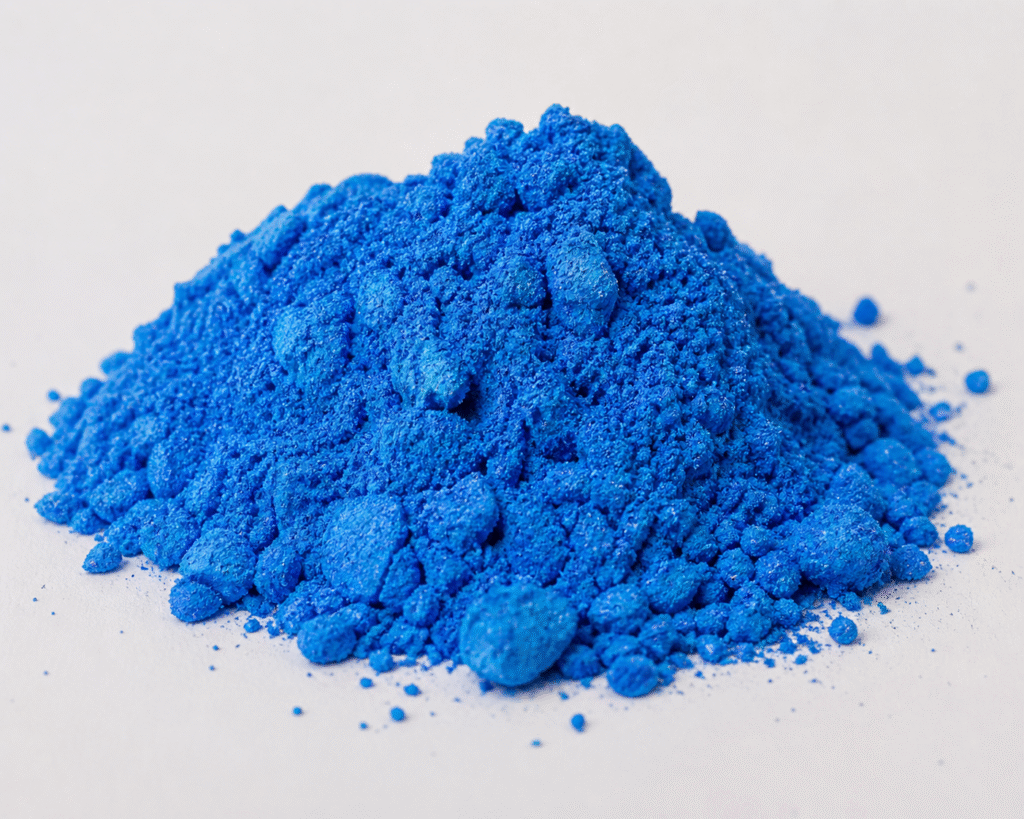
Formulated some 5,250 years ago, it is the earliest known synthetic pigment to have been used by man and can be found on statues, tomb paintings and sarcophagi. It was also used to produce a ceramic glaze known as Egyptian faience. The iconic crown of Nefertiti owes its vivid colour to Egyptian blue, a pigment used extensively in ancient Egypt.
How Egyptian Blue Was Made
It is made by heating a mixture of a calcium compound (typically calcium carbonate), a copper-containing compound (metal filings or malachite), silica sand and soda or potash as a flux. Egyptians were masters at controlling the firing of the raw materials with amazing accuracy, holding their kilns at a crucial temperature around 850-950 C.
Cultural and Symbolic Meaning
Due to its rarity, In Egyptian belief, blue was considered as the colour of the heavens, and hence the universe. It was also associated with water and the Nile. Thus, blue was the colour of life, fertility and rebirth.
Spread Across the Ancient World
Because this extremely important to the ancients colour was only occurring in a form of blue minerals like azurite and lapis lazuli, the manufacture of Egyptian Blue eventually spread beyond Egypt’s borders, and can be found throughout the Mediterranean.
Use in Greek and Roman Art
Egyptian Blue has been found in numerous Greek and Roman objects, including statues from the Parthenon in Athens and wall paintings in Pompeii. Despite its extensive application in art, Egyptian Blue ceased to be used, and its method of production was forgotten when the Roman era came to an end.
Rediscovery in the 19th Century
In the 19th century, Egyptian Blue was re-discovered. The excavations at Pompeii revealed that many wall paintings had Egyptian Blue on them, and this prompted scientists to investigate the exact composition of this pigment. Since then, researchers have gained a much deeper understanding of its unique properties.
Modern Scientific and Forensic Uses
Egyptian blue has a forensic potential too. It can be used as dusting powder to dust the prints at a crime scene because it emits near-infrared radiation that makes fingerprints glow.
Experiments found that Egyptian Blue has the highly unusual quality of emitting infrared light when red light is shone onto it. This emission is extraordinarily powerful and long-lived, but cannot be seen by the naked eye.
More articles:
Smithsonian Magazine: Archaeologists Are Recreating the Long-Lost Recipe for Egyptian Blue, the World’s Oldest Known Synthetic Pigment
Wikipedia: Egyptian blue – Wikipedia
Britannica: Nefertiti | Biography, Reign, Death, Tomb, Meaning, & Facts | Britannica